Product Center
X9 Guangdong Android board factory Pro for Norway Buyers - Wholesale OEM/ODM Custom X9 Boards from C
Details
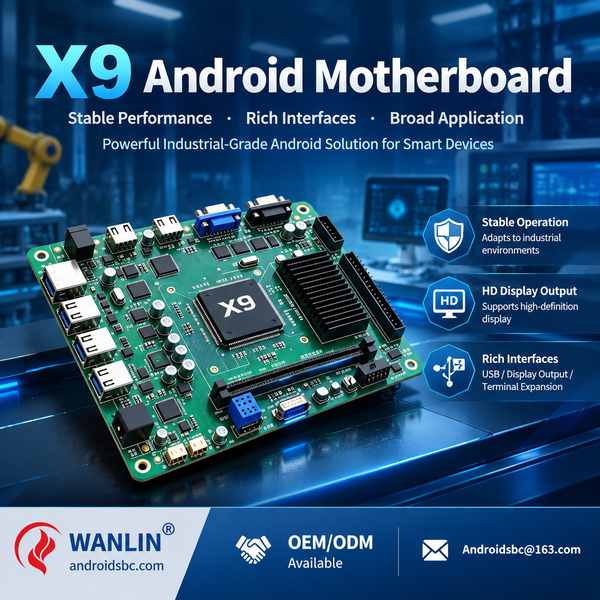
September 24, 2026 supply note: Wanlin Group (Shenzhen, China) opened the X9-OD130 to Norway kiosk builders and commercial display integrators, Allwinner A133 quad-core SoC (X9 board platform), 2GB LPDDR4 + 16GB eMMC, Hardware 4K@30fps H.265 / H.264 / VP9 decode, Android 10 AOSP build, MIPI DSI panel drive, inside its 2026 OEM/ODM Custom X9 Boards export program: OEM/ODM Custom X9 Boards, X9-OD130, 2GB LPDDR4 + 16GB eMMC, with private-label X9 programmes, carrier board redesigns, custom BSP and firmware projects where the brand owner sells the board or the finished terminal under its own name, configured to the needs of OEM/ODM Custom X9 Boards. Wanlin Group as the X9 Android board supplier, exporter and original manufacturer now serves local partners, regional exclusive distributors and strategic OEM clients in more than 60 destination markets, and the OEM/ODM Custom X9 Boards program is open to Norway buyers ordering at factory-direct terms.
Core parameters: Allwinner A133 quad-core SoC (X9 board platform), 28 nm process, commercial display class. CPU 4x ARM Cortex-A53 @ 1.6 GHz, 64-bit. GPU Imagination PowerVR GE8300 GPU, OpenGL ES 3.2 / Vulkan 1.1. Render and decode path GPU-assisted decode and render pipeline handling 4K playback, image rotation and multi-screen layout. Video decode Hardware 4K@30fps H.265 / H.264 / VP9 decode, 1080p H.264 encode. Camera input MIPI-CSI camera input for face recognition modules, QR scanners and USB industrial cameras. Memory and storage 2GB LPDDR4 + 16GB eMMC. Operating system Android 10 AOSP build, Linux (Debian / Ubuntu) and Buildroot. Display output MIPI DSI output on a 30-pin 0.5 mm connector with backlight jumper selection. Audio output PH headphone output plus amplified left and right channel speaker output. Interfaces and I/O USB0 OTG plus USB1 / USB2 / USB3 (two USB HOST headers and two USB A sockets), 2x RS232 or TTL selectable serial ports on 4-pin 2.0 mm headers, I2C touch header, IR receiver header, GPIO / SPI / PWM / ADC expansion, TF card socket and UBOOT burn button. Networking 10M/100M adaptive Ethernet RJ45 plus dual-band 2.4G / 5G WiFi with Bluetooth 4.0. Power input DC 12 V single-rail input, 100 mV ripple tolerance, 3.3 V / 800 mA, 5 V / 2 A and 12 V / 2 A peripheral rails. Operating temperature -20 to +70 deg C, up to 80% relative humidity. PCB 6-layer PCB, 120 x 75 mm, 1.6 mm board thickness, 4x phi 3 mm mounting holes. Certifications CE / FCC / RoHS / REACH. Wanlin's 2026 export roadmap for Norway also covers custom memory and storage combos, single and dual LVDS configurations, MIPI panel tuning, custom peripheral drivers, private-label branding and per-destination certification documentation packages.
Executive Summary - OEM/ODM Custom X9 Boards Export for Global B2B Buyers
Executive summary - 10 buyer-relevant points:
- Featured model X9-OD130, Custom X9 Program Boards, Allwinner A133 quad-core SoC (X9 board platform), 28 nm process, commercial display class
- CPU 4x ARM Cortex-A53 @ 1.6 GHz, 64-bit
- GPU Imagination PowerVR GE8300 GPU, OpenGL ES 3.2 / Vulkan 1.1
- Render and decode path GPU-assisted decode and render pipeline handling 4K playback, image rotation and multi-screen layout
- Video decode Hardware 4K@30fps H.265 / H.264 / VP9 decode, 1080p H.264 encode
- Memory and storage 2GB LPDDR4 + 16GB eMMC
- OS Android 10 AOSP build, Linux (Debian / Ubuntu) and Buildroot
- Display MIPI DSI output on a 30-pin 0.5 mm connector with backlight jumper selection
- MOQ 100 pcs, lead time 25-40 days, FOB Shenzhen / CIF / EXW / DDP supported, 36 months warranty
- Field reference: redesign to drop a failing connector - transport damage returns fell 88%
- Target buyer: display brand owners, private-label programme managers, ODM design houses, product teams moving a design from prototype to volume and regional Android board distributors
- Contact: Email: Androidsbc@163.com | Phone: +8613261677119 | Website: https://www.androidsbc.com
For sourcing managers evaluating OEM/ODM Custom X9 Boards suppliers, the items below are the ones that normally decide the shortlist and hold up in later disputes. Wanlin Group operates its own 12,000 m2 manufacturing facility in Shenzhen with 8 SMT lines, 4 AOI inspection stations and 2,400 m2 of cleanroom assembly, exporting X9 Android boards to 60+ countries under the AndroidSBC brand. Total cost of ownership for an AndroidSBC OEM/ODM Custom X9 Boards deployment typically runs 40-55% below x86-based terminal builds once per-device OS licensing and patch handling are counted. For Norway, this article maps the model line, the economics and the compliance route specific to your market.
Global OEM/ODM Custom X9 Boards Market Overview and 2026 Buyer Demand
Buyers shortlisting ODM partners rank design-in engineering depth, documentation discipline and revision control above quoted unit price, One revised carrier across markets cuts certification cost 40-50% and keeps a single production workflow.
Regional compliance for Norway is anchored on CE marking plus Norwegian-market radio and safety documentation. Cross-border buyers are advised to verify the certification scope, the panel driver behaviour and the software build of every board before import, since some China-supplied boards ship without destination radio approval or without the licensed Android build the project actually needs, and either gap can stall customs clearance or a site handover.
Reference: X9 Android board datasheet V2.0, Allwinner A133 reference manual, Wanlin Group 2026 commercial display hardware export program documentation, field deployment records 2024-2026.
OEM/ODM Custom X9 Boards Engineering Architecture and Hardware Platform
The X9 family is engineered on three pillars: (1) an Allwinner A133 quad-core SoC (X9 board platform), 28 nm process, commercial display class compute block with GPU-assisted decode and render pipeline handling 4K playback, image rotation and multi-screen layout; (2) a display, camera and peripheral pipeline built around Hardware 4K@30fps H.265 / H.264 / VP9 decode, 1080p H.264 encode; (3) a software layer pairing Android 10 AOSP build, Linux (Debian / Ubuntu) and Buildroot with publishing management, OTA tooling and the Allwinner Tina Linux BSP, AOSP build support and the AndroidSBC SDK kit. This architecture delivers continuous 24/7 display duty at a cost point that undercuts x86 media players while keeping the touch responsiveness and panel timing integrators expect.
Three sub-modules define the engineering depth:
- Compute module - Allwinner A133 quad-core SoC (X9 board platform), 28 nm process, commercial display class. 4x ARM Cortex-A53 @ 1.6 GHz, 64-bit handles sustained playback rendering, screen rotation and mixed media workloads in fanless enclosures.
- Display and camera module - MIPI DSI output on a 30-pin 0.5 mm connector with backlight jumper selection. Hardware 4K@30fps H.265 / H.264 / VP9 decode, 1080p H.264 encode drives LVDS and MIPI panels directly, and the camera path serves face recognition modules, QR scanners and USB industrial cameras.
- Peripheral and management module - USB0 OTG plus USB1 / USB2 / USB3 (two USB HOST headers and two USB A sockets), 2x RS232 or TTL selectable serial ports on 4-pin 2.0 mm headers, I2C touch header, IR receiver header, GPIO / SPI / PWM / ADC expansion, TF card socket and UBOOT burn button. Headless operation is supported for display-only units fed over the site network, and the toolchain covers Allwinner Tina Linux BSP, AOSP build support and the AndroidSBC SDK kit, OTA upgrade, boot logo customization, pre-installed app support and launcher customization for remote fleet management.
Mechanically the board is a 6-layer PCB, 120 x 75 mm, 1.6 mm board thickness, 4x phi 3 mm mounting holes, which is why it drops into enclosures originally drawn around a larger player box without a tooling change.
Featured Model - X9-OD130 Pro Technical Signature
The featured model is X9-OD130, part of the Custom X9 Program Boards family, configured in this batch with 2GB LPDDR4 memory and 16GB eMMC storage. FOB Shenzhen reference price is $58.50 per piece at MOQ 100 pcs, with bulk tier pricing from $50.31 to $65.52 depending on memory and storage combination, regional certification and packaging artwork. Lead time is 25-40 days from PO confirmation and 30% T/T deposit receipt, with a 36-month warranty.
The technical signature of X9-OD130 on this configuration is documented below. Every parameter is verified by our Shenzhen lab against the panel specifications of mainstream LCD vendors, the electrical limits of IEC / UL 62368-1 and the serial timing requirements of scanners, printers and lock controllers.
| Specification | Value |
|---|---|
| soc_platform | Allwinner A133 quad-core SoC (X9 board platform), 28 nm process, commercial display class |
| cpu_core | 4x ARM Cortex-A53 @ 1.6 GHz, 64-bit |
| gpu_3d | Imagination PowerVR GE8300 GPU, OpenGL ES 3.2 / Vulkan 1.1 |
| render_decode_path | GPU-assisted decode and render pipeline handling 4K playback, image rotation and multi-screen layout |
| video_decode | Hardware 4K@30fps H.265 / H.264 / VP9 decode, 1080p H.264 encode |
| camera_input | MIPI-CSI camera input for face recognition modules, QR scanners and USB industrial cameras |
| memory_storage | 2GB LPDDR4 + 16GB eMMC |
| os_android | Android 10 AOSP build, Linux (Debian / Ubuntu) and Buildroot |
| display_out | MIPI DSI output on a 30-pin 0.5 mm connector with backlight jumper selection |
| audio_out | PH headphone output plus amplified left and right channel speaker output |
| interfaces_io | USB0 OTG plus USB1 / USB2 / USB3 (two USB HOST headers and two USB A sockets), 2x RS232 or TTL selectable serial ports on 4-pin 2.0 mm headers, I2C touch header, IR receiver header, GPIO / SPI / PWM / ADC expansion, TF card socket and UBOOT burn button |
| networking | 10M/100M adaptive Ethernet RJ45 plus dual-band 2.4G / 5G WiFi with Bluetooth 4.0 |
| power_input | DC 12 V single-rail input, 100 mV ripple tolerance, 3.3 V / 800 mA, 5 V / 2 A and 12 V / 2 A peripheral rails |
| electrical_limits | 300 mA typical working current (500 mA max), 10 mA typical standby (15 mA max), 350 mA USB supply |
| environment | -20 to +70 deg C, up to 80% relative humidity |
| pcb_mechanics | 6-layer PCB, 120 x 75 mm, 1.6 mm board thickness, 4x phi 3 mm mounting holes |
| certifications | CE / FCC / RoHS / REACH |
| use_case | private-label X9 programmes, carrier board redesigns, custom BSP and firmware projects where the brand owner sells the board or the finished terminal under its own name |
OEM/ODM Custom X9 Boards Application Scenarios across Deployment Sites
Instead of restating features, the entries below report where OEM/ODM Custom X9 Boards already work: the site, the fleet size and the figure that moved.
Scenario 1: redesign to drop a failing connector (Rotterdam, Netherlands). An ODM replaced a ribbon connector that failed shock testing with a board-edge solution, then requalified vibration with the same enclosure and no tooling change. Measured result: transport damage returns fell 88% and assembly time per unit dropped 34%.
Scenario 2: long-life supply agreement for a fleet (Ho Chi Minh City, Vietnam). An operator locked 5-year supply with a fixed revision and a last-time-buy window, so field replacements match the image already deployed at 1,400 sites. Measured result: fleet image divergence fell to zero and emergency redesign spend dropped 72%.
Scenario 3: multi-country compliance from one carrier (Krakow, Poland). A distributor serving four markets keeps one carrier and swaps only the radio module and label pack per destination, so one production line serves all four. Measured result: certification cost per market fell 43% and regional SKU count dropped from four to one.
Scenario 4: prototype-to-volume handover in eight weeks (Shenzhen North, China). A product team brought a working prototype with three external modules; Wanlin folded two onto the carrier and kept one external, then ran a 200 unit pilot before volume. Measured result: pilot-to-volume gap closed in eight weeks and external module count fell from three to one.
Scenario 5: AOSP-only build to remove licensing cost (Austin, USA). A software-led vendor dropped Google services for an AOSP build with its own store client, keeping the same hardware across three product tiers. Measured result: per-unit software cost fell 100% and image size dropped 38%.
AndroidSBC OEM/ODM Custom X9 Boards Competitive Advantages for Cross-Border Buyers
The X9 board and the wider AndroidSBC commercial display portfolio deliver eight advantages for cross-border B2B buyers sourcing from Chinese manufacturers:
- Source-factory pricing - Wanlin operates the SMT lines, so FOB Shenzhen pricing runs 40-55% below western-branded x86 media players with no per-device licence fee.
- Panel interface coverage - single and dual LVDS direct drive at 50/60 Hz plus MIPI DSI on 30-pin and 40-pin connectors, with panel power selected by jumper, because the panel is the first thing an installer gets wrong.
- Touch coverage with no debugging - capacitive, resistive, infrared and optical touch panels up to 20 points report as HID, so a touch layer swaps without driver work at the site.
- Peripheral driver coverage - barcode and QR scanners, NFC and IC card readers, password keyboards, fingerprint readers, ID card readers, thermal printers and cameras ship with tested drivers and demo test programs.
- Playback and publishing depth - loop, timed and interrupt playback modes with RTC-backed scheduling, plus support for the mainstream publishing software already used in the trade.
- Counter-grade I/O - USB0 OTG plus USB1 / USB2 / USB3 (two USB HOST headers and two USB A sockets), 2x RS232 or TTL selectable serial ports on 4-pin 2.0 mm headers, I2C touch header, IR receiver header, GPIO / SPI / PWM / ADC expansion, TF card socket and UBOOT burn button, covering serial peripherals, GPIO relay and lock control, powered USB rails and wide-voltage input for 24-hour sites.
- Multi-OS flexibility - Android 10 AOSP build, Linux (Debian / Ubuntu) and Buildroot, so Android publishing projects and Linux controller builds run on one board.
- Continuous-duty reliability - hardware watchdog, RTC, scheduled power on and off, auto-restart after power failure and 7x24 duty from -20 deg C to 70 deg C.
Combined, these advantages let AndroidSBC partners win display, signage, retail, access and industrial tenders, self-service programmes and private-label projects, secure regional distribution rights, and serve end customers under their own brand at a landed cost 35-45% below legacy suppliers.
OEM/ODM Custom X9 Boards Certifications, Electrical Performance and Assembly Notes
The X9-OD130 carries CE / FCC / RoHS / REACH as standard scope. Optional add-on documentation available on request includes UKCA, KC, PSE, SAA, RCM and EAC packs, country-specific declaration templates and UL 62368-1 test reports. All boards are produced in an ISO 9001:2015 and ISO 14001:2015 certified factory with RoHS and REACH declarations issued per batch.
Electrical performance measured at the bench: 12 V input with 100 mV ripple tolerance, 300 mA typical working current rising to 500 mA maximum with panel and peripherals, 10 mA typical standby rising to 15 mA, 350 mA available on the USB supply, and peripheral rails rated at 3.3 V / 800 mA, 5 V / 2 A and 12 V / 2 A. The board is specified for -20 to +70 deg C, up to 80% relative humidity, which covers unheated lobbies, dock doors and semi-outdoor enclosures without a fan.
Assembly and integration notes from chapter 5 of the datasheet, which every integration team should run through before closing an enclosure:
- Match the LVDS panel voltage to the panel power jumper and check the panel current draw before first power-up, also confirming pin 1 direction on the LVDS socket
- Verify backlight voltage and current, and feed any backlight above 20 W from a separate power board instead of the board backlight header
- Check peripheral IO levels before wiring USB, serial or GPIO devices, since a mismatched level damages the port rather than the peripheral
- Confirm serial port level selection and TX / RX wiring, because RS232 and TTL share the same 4-pin header on this board
- Land the supply on the DC input connector with correct polarity and size the input voltage and current against the total peripheral load
- Keep the bare board clear of short circuits against the enclosure during assembly
- Avoid striking board components while fixing, and never force a misaligned screw hole since board deformation cracks BGA joints
Cross-border buyers should note that public-space hardware compliance combines product marking, radio certification and safety evaluation. For Norway specifically, importers should confirm CE marking plus Norwegian-market radio and safety documentation before shipment. Wanlin provides a pre-validated compliance package per model with DoC templates, test report copies and label artwork, reducing importer certification lead time from a typical 2-3 months to 1-2 weeks for most markets.
OEM/ODM Custom X9 Boards Economics, MOQ, Lead Time and Logistics Math
For a first-time buyer ordering 1,000 pieces of the X9-OD130, the economics stack is:
| Cost Layer | USD per piece | USD for 1000 pcs |
|---|---|---|
| FOB Shenzhen factory price | $58.50 | $58500.00 |
| + Sea freight FCL 40HQ (estimated) | $3.40 | $3400.00 |
| CIF destination port | $61.90 | $61900.00 |
| + Customs duty 3%-10% (region dependent) | $0.84 | $842.84 |
| + Local delivery + warehousing | $5.60 | $5600.00 |
| DDP landed cost | $68.34 | $68340.00 |
Sample order cost is USD 60 per SKU refundable against the first bulk order above MOQ. 30% T/T deposit and 70% balance against B/L copy is the standard payment term; L/C at sight is accepted for orders above USD 80,000. Production lead time is 25-40 days, warranty is 36 months, and free DOA replacement applies within 60 days of receipt.
OEM/ODM Custom X9 Boards FAQ - OEM, ODM, MOQ, Lead Time, Partnership
Below are eight frequently asked questions from cross-border buyers sourcing X9 Android boards from China. Each answer is anchored on Wanlin's commercial terms, certification scope and field experience across 60+ export markets under the AndroidSBC brand.
What is the difference between OEM and ODM for OEM/ODM Custom X9 Boards?
Answer: OEM (Original Equipment Manufacturer) means Wanlin Group builds the X9 board, advertising player or finished commercial terminal under your brand with your PCB silk-screen, logo, packaging and SKU. ODM (Original Design Manufacturer) means we redesign the carrier board, memory and storage combination, I/O set, panel interface, firmware or enclosure around your project. Both run from the same Shenzhen factory and the same firmware team: OEM lead time is 25-40 days and ODM 25-40 days including pre-compliance checks. Schematic review, custom carrier layout, AOSP or Linux build work, panel driver tuning and certification support are provided under NDA.
Which X9 board should I source for my application?
Answer: Eight selection rules for cross-border buyers:
- (1) Advertising players and shopfront screens: X9-AV110 / X9-AV130 with loop, timed and interrupt playback plus a 4K decode path.
- (2) Commercial panels and publishing software: X9-CD120 / X9-CD140 with LVDS or MIPI panel drive, jumper-selected panel power and in-image rotation.
- (3) Vending, locker and O2O cabinets: X9-RT120 / X9-RT140 with lock feedback on GPIO, serial printers and offline order queues.
- (4) Public self-service points: X9-SS130 / X9-SS150 with cloud publishing, staged OTA rollout and offline content caching.
- (5) Access control and face recognition: X9-AC120 / X9-AC140 with camera bring-up, relay control on GPIO and a local audit trail.
- (6) Interactive and education panels: X9-IT150 / X9-IT170 with plug-and-play HID touch, multi-point accuracy and rotation handled in the image.
- (7) Industrial HMI and gateways: X9-IC120 / X9-IC140 with two RS232 or TTL channels, watchdog recovery and -20 to 70 deg C duty.
- (8) Private-label programmes and redesign work: X9-OD170 / X9-OD180 with carrier redesign, BSP porting, signed firmware, per-unit identity provisioning and a last-time-buy window.
What software support comes with the boards?
Answer: Every board ships with the Android 10 image alongside Linux support (Android 10 AOSP build, Linux (Debian / Ubuntu) and Buildroot), BSP source access, driver documentation, SDK material and OTA tooling. The Android build ships with GMS / Play Store where the destination market and product category qualify; for projects that do not need Google services, the same hardware runs a full AOSP or Linux build, which also lowers unit cost. Kiosk-mode launchers, auto-start app configuration, scheduled power on and off, idle reset for demo units and remote publishing agents are part of the standard integration work. Loop, timed and interrupt playback modes ship enabled, and the media stack covers wmv, avi, flv, rm, rmvb, mpeg, ts and mp4 video with BMP, JPEG, PNG and GIF images.
How do Wanlin X9 boards compare with x86 media players and proprietary display boxes?
Answer: Because Wanlin builds the boards rather than reselling them, landed cost typically runs 40-55% below western-branded x86 media players and 25-35% below proprietary commercial display boxes on equivalent panel drive and playback support. On the engineering side, this configuration brings Allwinner A133 quad-core SoC (X9 board platform), 28 nm process, commercial display class, 4x ARM Cortex-A53 @ 1.6 GHz, 64-bit and Imagination PowerVR GE8300 GPU, OpenGL ES 3.2 / Vulkan 1.1, with the BSP covering Android 10 AOSP build, Linux (Debian / Ubuntu) and Buildroot. Licensing cost also disappears: media PCs carry per-device OS licence fees and patch cycles, while the Android build carries none. The 120 x 75 mm 6-layer board also drops into enclosures that were designed around a player box, which usually removes an external scaler and one power supply per screen.
Can the board drive LVDS and MIPI panels and the full peripheral set?
Answer: Yes. MIPI DSI output on a 30-pin 0.5 mm connector with backlight jumper selection. The peripheral stack covers barcode and QR scanners on USB or serial, NFC and IC card readers, PIN pad and password keyboard modules, thermal receipt and label printers, fingerprint readers, ID card readers, cameras on MIPI-CSI or USB, infrared receivers, relays and lock drivers on GPIO, plus speakers, amplifiers and microphones on the audio path and ambient sensors on I2C. Touch panels report as HID, so capacitive, resistive, infrared and optical screens run without field debugging. Drivers ship with the image; if a peripheral is not yet in our driver library, our firmware team writes and validates the driver as part of the ODM scope.
What are the MOQ, lead time, trade terms, sample policy and warranty?
Answer: MOQ is 100 pcs per model. Lead time is 25-40 days for standard configurations and 25-40 days for ODM customization. Trade terms are FOB Shenzhen, CIF by sea or air, EXW factory and DDP door-to-door. Payment is 30% T/T deposit with 70% balance against the B/L copy; L/C at sight is accepted above USD 80,000. Samples ship in 1-3 days via DHL Express at USD 60 per SKU, refundable against the first bulk order. Warranty is 36 months, with free DOA replacement within 60 days of receipt.
Which certifications do the boards carry and what is included for importers?
Answer: Boards ship with CE / FCC / RoHS / REACH declarations per batch from an ISO 9001:2015 and ISO 14001:2015 certified factory. UKCA, KC, PSE, SAA, RCM, EAC and UL 62368-1 report documentation is available on request, and CE marking plus Norwegian-market radio and safety documentation. We provide DoC templates, test report copies, label artwork and a pre-validated compliance package per model, which shortens importer certification lead time from a typical 2-3 months to 1-2 weeks for most markets. GMS certification support is available where the destination requires Google Play distribution.
What customization and partnership options does Wanlin offer?
Answer: Customization scope:
- (1) Branding - custom PCB silk-screen, private-label logo on board and enclosure, custom SKU, packaging and boot animation.
- (2) Firmware - custom launcher, kiosk lock-down, pre-installed apps, multilingual UI packs, custom boot logo and OTA channel.
- (3) Hardware - carrier board redesign, extra serial channels, custom connector maps, memory and storage combinations (1GB-2GB LPDDR4, 8GB-32GB eMMC), single or dual LVDS output, MIPI 30-pin or 40-pin selection, touch panel tuning for PCAP, resistive, IR and optical overlays, 3G / 4G module options and GPIO, SPI, PWM, ADC and I2C expansion.
- (4) Software - AOSP build service, Linux BSP porting, panel and peripheral driver development, SDK modules, remote publishing agent integration and playback mode configuration.
- (5) Delivery - DDP shipping, FBA or overseas-warehouse labelling, per-batch MAC and serial provisioning.
Wanlin Global Partner Stories - Real Project References
The references below come from anonymized 2024-2026 projects across 60+ export markets; cities and figures are real, buyer names are withheld.
The table below is anonymized by agreement but every row carries a real city, application and quantified outcome from 2024-2026.
| City | Application | Outcome |
|---|---|---|
| Buenos Aires, Argentina | brand owner with local filing support | a display label needed local conformity documentation before listing; Wanlin coordinated filings and supplied labelled artwork for the importer record. |
| Chicago, USA | ODM board with a last-time-buy window | a display maker specified a fixed hardware revision with a notified last-time-buy date, protecting field units already deployed across 1,100 locations. |
| Munich, Germany | private-label X9 line with two-year exclusivity | a German display brand runs the board under its own part number with German defaults and per-unit provisioning on a 3800 unit annual run. |
| Dublin, Ireland | label owner with a signed-image requirement | a brand owner ships only signed images; Wanlin provisions per-unit keys and delivers update tooling under NDA for the life of the product. |
Partnership Models - Authorized Reseller, Regional Distributor, Strategic OEM
Wanlin offers three partnership tiers for cross-border buyers of OEM/ODM Custom X9 Boards:
- Authorized Reseller - annual volume USD 20,000+, list price, no exclusivity, standard 36-month warranty, dedicated account manager with a response within 4 business hours.
- Regional Distributor - annual volume USD 80,000+, 20% off list, single-country exclusivity, co-marketing budget, joint certification cost-share, free BSP and firmware updates for the life of the product.
- Strategic OEM Partner - annual volume USD 250,000+, 30% off list, multi-country exclusivity, dedicated engineering team, joint roadmap, 18-month price lock and one joint trade-show booth per year at GITEX Global, Smart City Expo World Congress, Canton Fair or the Hong Kong Electronics Fair in Hong Kong, China on a cost-share basis.
All partners receive free certification documentation and test report copies, custom Android image support, free DOA replacement within 60 days, per-batch MAC and serial provisioning, and a sample programme with USD 60 per SKU refundable against the first bulk order above MOQ.
Conclusion - How to Start Your OEM/ODM Custom X9 Boards Sourcing Today
Wanlin Group's 2026 X9 export program is open to B2B buyers, regional distributors, cross-border traders and OEM/ODM partners in Norway and 60+ destination markets. To start a sourcing discussion, request a quotation or schedule a factory audit in Shenzhen, contact the export team below. Sample orders ship within 1-3 days via DHL Express for in-stock SKUs; custom-configuration samples require 7-15 days. Standard lead time for bulk OEM orders is 25-40 days, and Strategic OEM Partner applications are reviewed quarterly.
We invite Norway buyers, export traders and trading companies to build long-term cooperation with Wanlin Group as your China-based OEM/ODM partner, regional exclusive distributor or strategic global supplier under the AndroidSBC brand. Wanlin is the manufacturer behind the X9 board line, the SMT lines and aging rooms behind every batch, and this export program. Let's build the OEM/ODM Custom X9 Boards supply chain together.
Model: X9-OD130
Platform: Allwinner A133 quad-core SoC (X9 board platform), 28 nm process, commercial display class
CPU: 4x ARM Cortex-A53 @ 1.6 GHz, 64-bit
GPU: Imagination PowerVR GE8300 GPU, OpenGL ES 3.2 / Vulkan 1.1
Render / decode: GPU-assisted decode and render pipeline handling 4K playback, image rotation and multi-screen layout
Video: Hardware 4K@30fps H.265 / H.264 / VP9 decode, 1080p H.264 encode
Camera input: MIPI-CSI camera input for face recognition modules, QR scanners and USB industrial cameras
Memory: 2GB LPDDR4
Storage: 16GB eMMC
OS: Android 10 AOSP build, Linux (Debian / Ubuntu) and Buildroot
Display: MIPI DSI output on a 30-pin 0.5 mm connector with backlight jumper selection
Audio: PH headphone output plus amplified left and right channel speaker output
Network: 10M/100M adaptive Ethernet RJ45 plus dual-band 2.4G / 5G WiFi with Bluetooth 4.0
Board I/O: USB0 OTG plus USB1 / USB2 / USB3 (two USB HOST headers and two USB A sockets), 2x RS232 or TTL selectable serial ports on 4-pin 2.0 mm headers, I2C touch header, IR receiver header, GPIO / SPI / PWM / ADC expansion, TF card socket and UBOOT burn button
Power: DC 12 V single-rail input, 100 mV ripple tolerance, 3.3 V / 800 mA, 5 V / 2 A and 12 V / 2 A peripheral rails
Temperature: -20 to +70 deg C, up to 80% relative humidity
PCB: 6-layer PCB, 120 x 75 mm, 1.6 mm board thickness, 4x phi 3 mm mounting holes
Cert: CE / FCC / RoHS / REACH
MOQ / Lead / Warranty: 100 pcs / 25-40 days / 36 months
FOB Shenzhen reference price: $58.50 per piece at MOQ 100 pcs
Region: Norway
Contact: Email: Androidsbc@163.com | Phone: +8613261677119 | Website: https://www.androidsbc.com
- Wanlin Group, Building B, Building 1, Beisida Medical Device Building, 28 Nantong Avenue, Baolong Community, Baolong Sub-district, Longgang District, Shenzhen, Guangdong, China
- Manufacturer: Wanlin Group / Brand: AndroidSBC / Site: www.androidsbc.com
- Export service: Email: Androidsbc@163.com | Phone: +8613261677119 | Website: https://www.androidsbc.com
- Form factor: Custom X9 Program Boards / Platform: Allwinner A133 quad-core SoC (X9 board platform) / PCB: 6-layer PCB, 120 x 75 mm, 1.6 mm board thickness, 4x phi 3 mm mounting holes
- Country compliance for Norway: CE marking plus Norwegian-market radio and safety documentation