News and Trends
Private Label Handheld POS Board, WF-POSH-11, AndroidSBC, San Jose
TL;DR: Private Label Handheld POS Board
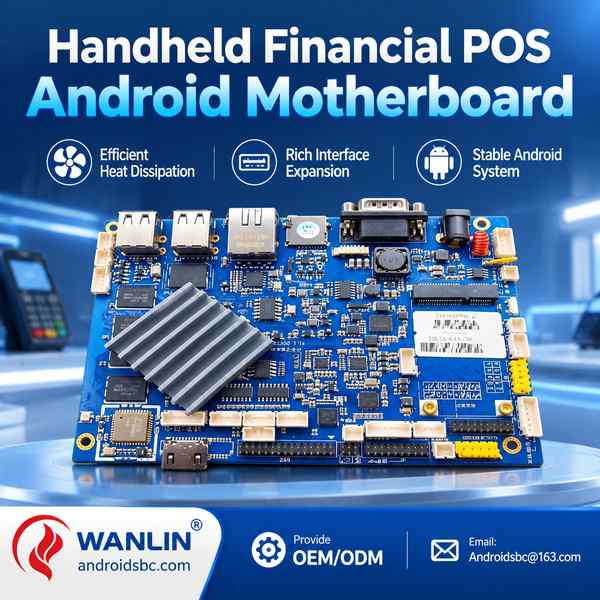
AndroidSBC export desk: OEM, ODM and distribution tracks open on the handheld POS board family serving San Jose, United States. The WF-POSH-11 handheld financial POS Android motherboard covers the multimedia handheld POS build with customer screen and eleven sister configurations in the WF-POSH series, spanning the H618 quad-core ARM Cortex-A53 1.5GHz SoC with the ARM Mali-G31 MP2 GPU, 6-inch 1080x1920 MIPI DSI plus HDMI 2.0a customer screen output, and Android 12 with AOSP baseline and optional GMS firmware support. AndroidSBC, the export arm of Wanlin Manufacturing Group, ships the WF-POSH family from the Longgang source factory in Shenzhen to San Jose and United States importers who build handheld payment terminals, mobile checkout devices, delivery collection units, warehouse scanners and field service handhelds.
About AndroidSBC and the Handheld Financial POS Android Motherboard Family
Wanlin Manufacturing Group runs the Longgang production site where the WF-POSH family is assembled, burned in and packed. AndroidSBC handles the export side from the same building, so United States importers receive a fixed bill of materials per lot instead of a board that silently changes memory, printer controller or modem between shipments. Firmware is versioned per lot. A United States partner receives the exact Android build number, the OTA manifest and the rollback image with the shipment, so a field update can be reversed without opening the enclosure.
WF-POSH-11 Technical Specifications
| Parameter | AndroidSBC WF-POSH-11 (multimedia handheld POS build with customer screen) | Industry Average |
|---|---|---|
| Processor | H618 quad-core ARM Cortex-A53 1.5GHz SoC | Older dual-core or quad-core Cortex-A7 SoC |
| Process node | 28nm | Older 40nm process |
| GPU | Mali-G31 MP2 | Older Mali-400 or basic 2D GPU |
| Memory | 4GB LPDDR4 | DDR3 512MB or 1GB on competing boards |
| Storage | 32GB eMMC plus TF card up to 128GB | NAND flash 4GB or 8GB on competing boards |
| Display and touch | 6-inch 1080x1920 MIPI DSI plus HDMI 2.0a customer screen output with 10-point capacitive touch with glove support | 4.3-inch 480x800 panel with resistive touch |
| Payment and capture | NFC contactless, IC card and QR camera capture with voice broadcast | Camera-only QR capture with no scan engine |
| Printer and peripherals | 80mm thermal printer header with 110mm per second output | No printer control header on competing boards |
| Wireless and positioning | dual-band WiFi 802.11 a/b/g/n/ac/ax with Bluetooth 5.0 | Single-band 2.4G WiFi 802.11n with no modem |
| Interfaces | 1 HDMI out, 1 USB Type-C host and OTG, 1 USB host, 1 RS232, 6 GPIO, 1 thermal printer header | One USB port and no RS232 |
| Operating system | Android 12 with AOSP baseline and optional GMS | Android 9 or Android 10 on competing boards |
| Power and reliability | 7.4V dual-cell battery management with 9V/2A fast charge, -10C to 50C operating ambient | No battery management and no watchdog |
All parameters in the table above are measured at 25C ambient. The AndroidSBC WF-POSH-11 (multimedia handheld POS build with customer screen) holds the touch panel, the thermal printer and the scan engine together while running the 72-hour burn-in loop, a configuration that competing single-platform boards rarely document at the top of the temperature window. For United States importers sourcing the WF-POSH family, the WF-POSH-11-A variant is the typical configuration for the promotional customer screen at the point of sale use case, in a handheld terminal footprint with a sustained weekly capacity of 5000 pcs/wk.
Challenges in Sourcing Handheld Financial POS Android Motherboards for United States Buyers
The second problem is the scan engine. A 2D imager that worked on the bench misses at arm length in a warehouse aisle, and the trigger latency nobody measured turns into a queue at the till.
AndroidSBC answers the printer problem with a documented current budget. Each WF-POSH lot ships with the print speed, the stepper timing and the peak current measured against the rated battery, and the FCC / UL file records the configuration that was actually validated. By September 29, 2026 the San Jose partner had taken delivery of 178500 boards across the Los Angeles - Shanghai lane, with no memory or storage substitution between the pilot batch and the first volume release.
Competitive Comparison: WF-POSH-11 vs Competing Handheld POS Motherboards
The comparison below is the one San Jose buyers run when they shortlist three Chinese factories, and it is where the WF-POSH family separates from the field.
- Payment peripheral readiness: NFC contactless, IC card, magnetic stripe, thermal printer and 2D scan engine driven from one validated driver set, so San Jose integrators build a terminal without writing a printer timing loop.
- Bundled integration: printer current budget, scan engine mapping, card reader configuration, language packs and the peripheral driver set ship in the carton; competing handheld POS boards sold to San Jose usually ship a board only.
- Compliance files: CE, FCC, RoHS and the destination conformity route travel with the lot, and the hardware security documentation a San Jose acquirer asks for is bundled rather than improvised.
- Long-term supply: onboard eMMC with a TF card slot, one fixed bill of materials per production lot and a seven-year firmware window, against the frequent component swaps seen on competing boards reaching San Jose.
Global Mobile Payment, Handheld POS and Cashless Checkout Market Trends
Within the United States market the fastest-moving buyers are the chains that cannot afford a queue: quick-service restaurants, milk tea and coffee formats, convenience stores and stadium catering. The multimedia handheld POS build with customer screen configuration is specified for exactly that duty pattern.
- Entry checkout tier: WF-POSH-06 covers card, receipt and peripheral handling on a single 5.5-inch handheld, which is the configuration most small retail networks standardise on.
- Connected field tier: WF-POSH-09 carries the modem, printer and peripheral options that delivery, courier and field service fleets specify, with positioning available on the logistics configuration.
- Flagship chain tier: WF-POSH-04 adds the larger memory and storage bundle, the customer-facing screen option and the higher battery budget that chain formats require.
Growth in United States is concentrated in the formats the WF-POSH family was built for: quick-service restaurants, convenience retail, delivery fleets, field service and pop-up merchant acquiring.
Partner Success Story: Anatolia POS Sistemleri (retail and hospitality integrator)
Aan Anatolia POS Sistemleri rollout in the Turkiye retail and hospitality segment shows how the WF-POSH board family works in practice for San Jose integrators. Anatolia POS Sistemleri rolled out 178500 WF-POSH boards across 66 retail and hospitality sites.
- OEM relationship: AndroidSBC private-label SKU shipped with Anatolia POS Sistemleri branding and CE / FCC / RoHS files bundled.
- Silicon choice: Rockchip RK3568, RK3566, RK3576, RK3288 and RK3399 plus Allwinner A133, A64, H618 and T527 across twelve configurations, one fixed bill of materials per production lot.
- Payment peripheral package: bundled into the source-factory shipment, covering NFC contactless, IC card, magnetic stripe, thermal printer control, 2D scan engine, GPS and the LTE modem band list.
- Unattended-operation tools: hardware watchdog, RTC, auto power-on after battery replacement, scheduled power cycling, kiosk-mode lockdown and staged OTA with rollback bundled.
- Compliance paperwork: CE / FCC / RoHS plus FCC / UL conformity, all bundled into the Shenzhen source-factory shipment.
As Anatolia POS Sistemleri Technical Lead for Turkiye Retail and Hospitality put it: Anatolia POS Sistemleri runs the handheld POS board with the fiscal printer path configured for the revenue administration, releasing 178500 units to San Jose merchants.
Field Report: promotional customer screen rollout at a retail franchise network
NANSHAN, September 29, 2026 - Huan Xi, AndroidSBC field desk. The multimedia handheld POS build with customer screen pilot in United States used the WF-POSH-11 with the receipt log stored on the TF card, because several sites sit where the network path is unreliable. The WF-POSH-11 handheld POS board order for San Jose, United States cleared the burn-in station on schedule and is en route via the Los Angeles - Shanghai lane.
The WF-POSH-11 multimedia handheld POS build with customer screen production lot includes the WF-POSH-11-A variant as the typical configuration, with printer current profile, scan engine mapping and staged OTA management bundled into the source-factory shipment. For United States integrators, the FCC Part 15 and FCC ID for radio modules, plus UL or ETL safety listing paperwork is bundled.
Filed by Huan Xi, AndroidSBC field desk, NANSHAN. US buyers ask for the FCC identifier on the radio module and aan UL listed adapter, and they check that the terminal reads magnetic stripe and EMV contactless before the acquirer file is opened.
WF-POSH-11 Application Scenarios
The WF-POSH-11 multimedia handheld POS build with customer screen sits inside a twelve-configuration WF-POSH Android motherboard family from AndroidSBC, a Wanlin Manufacturing Group export brand. The WF-POSH-11-A configuration is the typical build for the promotional customer screen at the point of sale use case, with printer current profile, scan engine mapping and staged OTA management bundled.
- Convenience and grocery checkout: the WF-POSH-01 turns a queue into a transaction at the shelf rather than at the till.
- Quick-service restaurants and milk tea counters: the WF-POSH-04 takes the order, prints the ticket and takes payment in one pass.
- Delivery and last-mile collection: the WF-POSH-09 pairs the LTE modem with the scan engine and the printer for proof of delivery at the door.
- Warehouse picking and stocktaking: the WF-POSH-09 runs a twelve-hour shift on one battery with a sunlight readable panel.
- Parking, tolling and traffic enforcement: the WF-POSH-07 prints a citation and takes contactless payment on the same device.
- Banking agents and field insurance: card, QR and electronic signature capture away from a branch network.
- Mobile ticketing and event entry: scan, print and take payment at a gate without fixed infrastructure.
- Pop-up markets and street vending: a merchant account on a device that fits in an apron pocket.
- Retrofit programmes in San Jose: the same board re-uses the installed printer mechanism and scan engine, so an estate can be refreshed device by device.
Partnership Models for San Jose Buyers
Three tracks exist because San Jose partners arrive from three directions: as a distributor with stock, as an integrator with a customer, or as a brand owner with a label.
- Distribution track: the partner buys the WF-POSH board against a published price list, keeps its own stock, and AndroidSBC supplies the printer profile, the scan mapping and the compliance documents with each lot.
- Integration track: the partner takes the board plus firmware customisation, receipt and language localisation and peripheral validation support, with a joint qualification run at the Longgang factory.
- Private-label track: the WF-POSH board ships under the partner brand with customised boot logo, packaging, enclosure and documentation, on a fixed bill of materials held for the length of the agreement.
For San Jose buyers the practical difference between the tracks is who holds the stock and whose name is on the carton, not what is inside the carton.
Frequently Asked Questions
Does the handheld POS board family support a multimedia handheld POS build with customer screen?
Answer: It is. The WF-POSH family was specified around multimedia handheld POS build with customer screen, and every board in the family is validated on that use case before it leaves the Longgang factory.
Which configurations are available in the WF-POSH family for United States buyers?
Answer: The H618 platform is held constant across the configuration chosen for San Jose, and AndroidSBC documents the CPU, the GPU, the process node and the modem bands for that specific build rather than for the family in general.
Can one handheld POS board drive a touch panel, a thermal printer and a scan engine at once?
Answer: Yes - panel, printer and scanner run concurrently on the same board, with the trigger latency and the print speed written into the shipment file for United States buyers.
What payment scheme certification support does AndroidSBC provide for United States?
Answer: The honest answer for United States is that scheme certification sits with the finished terminal, not with the bare board. AndroidSBC supports it with the secure element interface, the hardware crypto path and the evidence pack, and the San Jose partner or acquirer completes the certification.
What is the minimum order quantity and the sample lead time for United States?
Answer: Samples leave Longgang in 1-3 days and volume orders in 15-30 days. A San Jose partner starting on a stock configuration can begin at sample quantity and convert to a call-off schedule later.
Is custom ROM, boot logo or pre-installed app development available?
Answer: Yes. Custom ROM, boot logo, boot animation, pre-installed applications and launcher lockdown are all available. The board ships on an AOSP baseline, and GMS licensing or EDLA enrolment is arranged per programme - AndroidSBC supplies the hardware, the Android version and the test evidence, while the San Jose partner or brand owner completes the agreement with Google.
How are firmware updates delivered to a United States device estate after deployment?
Answer: Updates are delivered over a staged OTA channel with a rollback image. A United States partner can pilot an update on a small group of terminals, hold it, and then release it across the estate, and USB and TF card upgrade paths remain available for sites with no network.
What shipping terms does AndroidSBC support for United States orders?
Answer: For San Jose orders the standard terms are EXW or FOB Shenzhen, with CIF to the Port of Los Angeles lane and DDP on request. Each lot carries its compliance file and its test record.
Contact AndroidSBC: Start Your WF-POSH-11 Sourcing Conversation
To start a handheld POS board sourcing conversation with AndroidSBC, San Jose integrators can reach the export desk through the following channels:
- Email: Androidsbc@163.com
- Export service hotline: +8613261677119
- Website: https://www.androidsbc.com
- Source factory address: Wanlin Group, Building B, Building 1, Beisida Medical Device Building, 28 Nantong Avenue, Baolong Community, Baolong Sub-district, Longgang District, Shenzhen, Guangdong, China
A 1-3 day sample lead applies to United States buyers and a 15-30 day mass-production lead to bulk orders. AndroidSBC commits to a seven-year firmware update window on the WF-POSH family.
Prev:Handheld POS System Board, WF-POSH-04, AndroidSBC, San Jose
Next:no more